

Every March 3rd, the world celebrates World Wildlife Day — and there is no better place to feel its meaning than standing on a volcanic shoreline in the Galapagos, watching a marine iguana slip into the sea or a giant tortoise move silently through the mist. We’ve put together this guide to help you discover the most iconic species of the archipelago, understand why this place matters so deeply, and imagine what it would feel like to experience it all for yourself — intimately, responsibly, and in a way you’ll never forget.
Why World Wildlife Day Matters — and Why It Feels Most Alive in the Galapagos
Every year on March 3rd, the world pauses to acknowledge something that should never be taken for granted: the staggering, irreplaceable diversity of life on our planet.
World Wildlife Day, established by the United Nations General Assembly in 2013, is more than a date on the calendar — it’s a global call to protect the species and ecosystems that sustain all life on Earth. At Ecoventura, this day holds a special place in our hearts. Because when we think about where that call resonates most deeply, there is one place that comes to mind above all others: the Galapagos Islands.
Few destinations on Earth can match the raw, unfiltered power of the Galapagos. Here, wildlife doesn’t retreat from humans — it ignores us, approaches us, and lives entirely on its own terms. Sea lions nap on sun-warmed rocks just inches from your feet. Marine iguanas bask in prehistoric stillness along volcanic shores. Giant tortoises move through misty highland forests as if time itself has slowed. This is what wildlife in its purest form looks like, and it’s something we are privileged to witness every single day aboard our expedition yachts.
The Galapagos Islands are home to an extraordinary concentration of endemic species — animals found nowhere else on Earth — and remain one of the most important biodiversity hotspots on the planet. As a
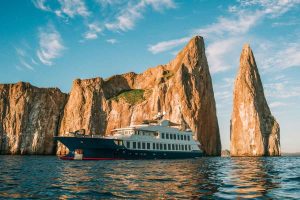
UNESCO World Heritage Site and one of the most strictly protected natural reserves in the world, the archipelago stands as proof that conservation works. At Ecoventura, our entire model is built around that belief. Every voyage we offer aboard Origin, Theory, and Evolve is designed not just to show you this world, but to protect it — now and for the generations that will come after us.
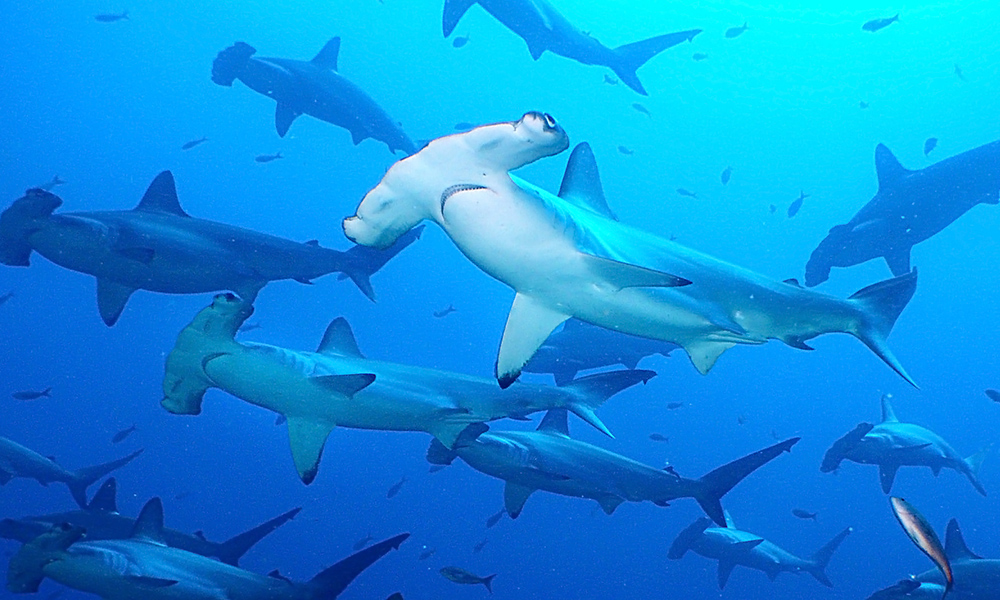
Wildlife Fact Sheets: The Iconic Species of the Galapagos Islands
Part of what makes any voyage through the Galapagos so transformative is the intimacy of the encounters. On our small-ship expeditions — with a maximum of 20 guests — you don’t just see these animals; you truly observe them. Here are the species that never fail to leave our guests breathless.
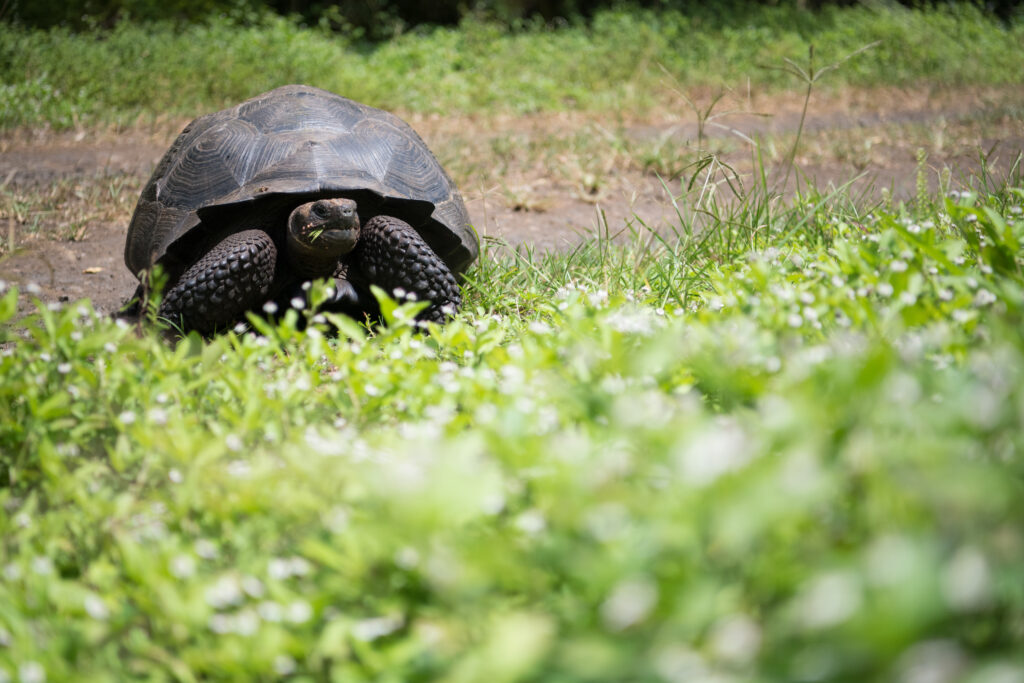
Galapagos Giant Tortoise (Chelonoidis spp.)
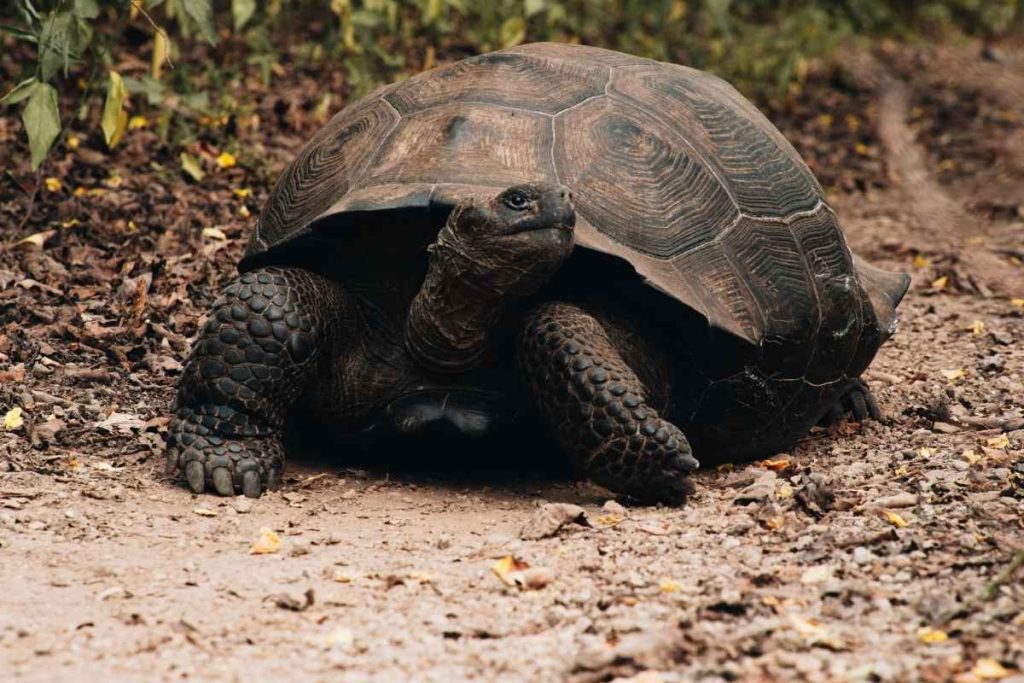
Conservation Status: Vulnerable (IUCN Red List) | Habitat: Highland forests and arid lowlands | Unique Adaptation: Can live over 100 years; capable of surviving up to a year without food or water | Ecological Role: Keystone species — their grazing patterns shape entire ecosystems | Where You’ll Meet Them: Highland reserves and breeding centers on Santa Cruz and Isabela Islands | Conservation Insight: Once near extinction due to hunting and invasive species, breeding programs have successfully restored multiple tortoise populations — one of conservation’s greatest success stories.
For us at Ecoventura, standing quietly beside a Galapagos giant tortoise in the misty highlands is one of the most humbling experiences we know. These animals walked these islands before Darwin, before maps, before any of us.
Marine Iguana (Amblyrhynchus cristatus)
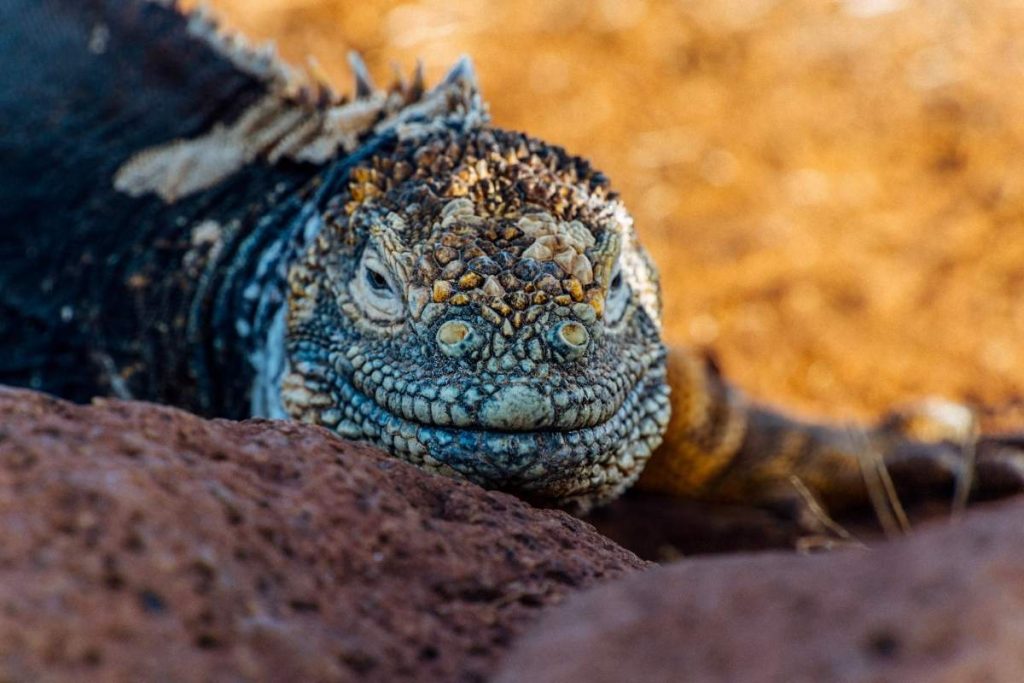
Darwin famously called them “disgusting clumsy lizards.” We respectfully disagree. The marine iguana is one of the most extraordinary animals on Earth — and a perfect symbol of Galapagos evolution at its most creative.
Conservation Status: Vulnerable | Habitat: Rocky volcanic shorelines | Unique Fact: The only sea-going lizard in the world, capable of diving over 30 feet to feed on underwater algae. They are also found in different color variations across different islands, with the Española subspecies being among the most vivid — often called the “Christmas iguana” for its red and green markings.
During our coastal landings, guests frequently encounter entire colonies of marine iguanas — dozens of them piled together for warmth, utterly unbothered by curious observers. Ecological role: As primary consumers of marine algae, they play a crucial role in regulating intertidal zones. Their conservation is closely tied to El Niño events, which reduce algae availability and can cause significant population crashes.
Blue-footed Booby (Sula nebouxii)
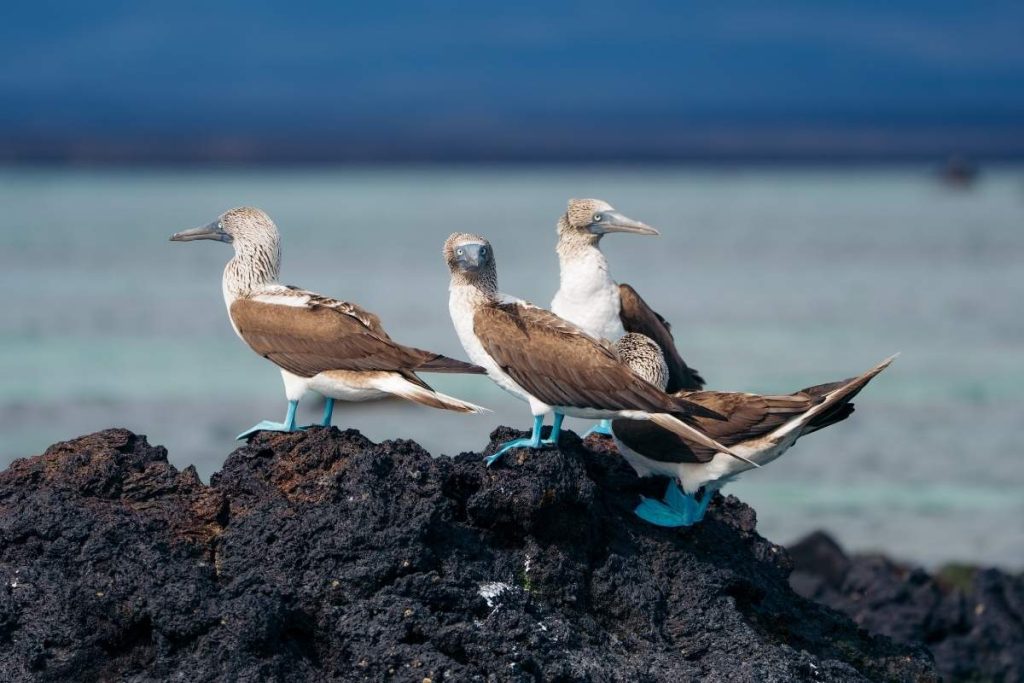
Ask any Ecoventura guest which animal made them laugh and gasp in equal measure, and the answer is almost always the blue-footed booby. Conservation Status: Least Concern | Habitat: Coastal cliffs and open rocky terrain
The booby’s courtship dance — a slow, deliberate, high-stepping display of those impossibly blue feet — is pure theater. The brighter the feet, the more attractive the mate; those vivid colors signal nutritional health and genetic fitness. Nesting colonies can be found on several islands throughout our itineraries, and witnessing a mating display up close is one of those moments that stays with you long after you’ve returned home.
Galapagos Penguin (Spheniscus mendiculus)
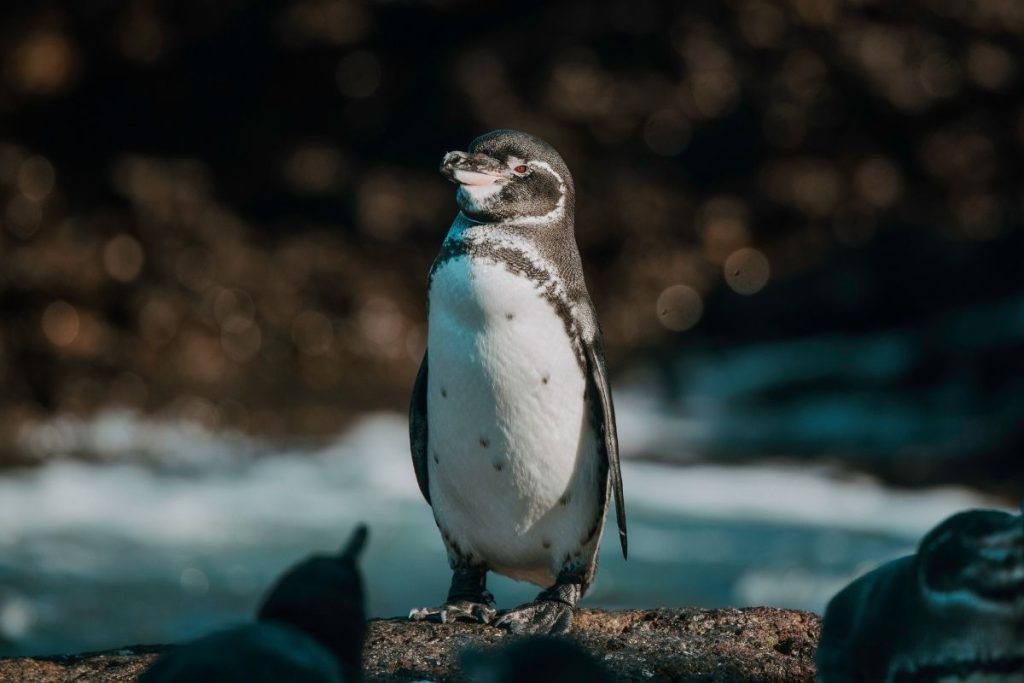
The Galapagos penguin is one of the world’s most remarkable ecological anomalies: the only penguin species found north of the equator, thriving in the tropics thanks to the cold Humboldt and Cromwell ocean currents. Conservation Status: Endangered | Habitat: Western islands, primarily Fernandina and Isabela
With a population estimated at fewer than 2,000 individuals, encountering a Galapagos penguin — whether waddling along a lava shoreline or darting beneath you while snorkeling — is one of the rarest and most thrilling wildlife moments available anywhere on Earth. Aboard our western itineraries on Theory and Evolve, guests regularly have the privilege of snorkeling alongside these little birds. It is, without question, a life-changing experience.
Galapagos Sea Lion (Zalophus wollebaeki)
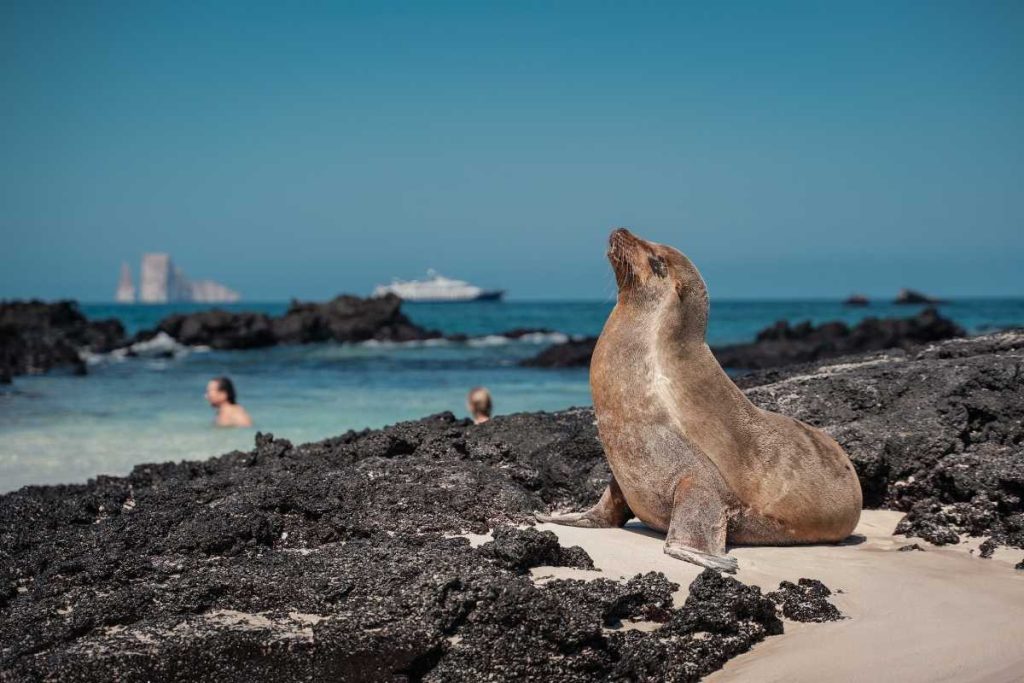
No other animal in the Galapagos captures pure, uninhibited joy quite like the Galapagos sea lion. They are the archipelago’s unofficial ambassadors — curious, playful, and utterly unafraid.
- Conservation Status: Endangered
- Habitat: Beaches, rocky shores, and nearshore waters throughout the archipelago
- Unique Behavior: Highly social; pups have been known to approach snorkelers and imitate human movements underwater
- Snorkeling Insight: Snorkeling with Galapagos sea lions is one of the most exhilarating marine wildlife experiences in the world — and it happens on nearly every Ecoventura itinerary.
- Conservation Concern: Population vulnerable to El Niño events and entanglement in fishing gear.
Galapagos Hawk (Buteo galapagoensis)
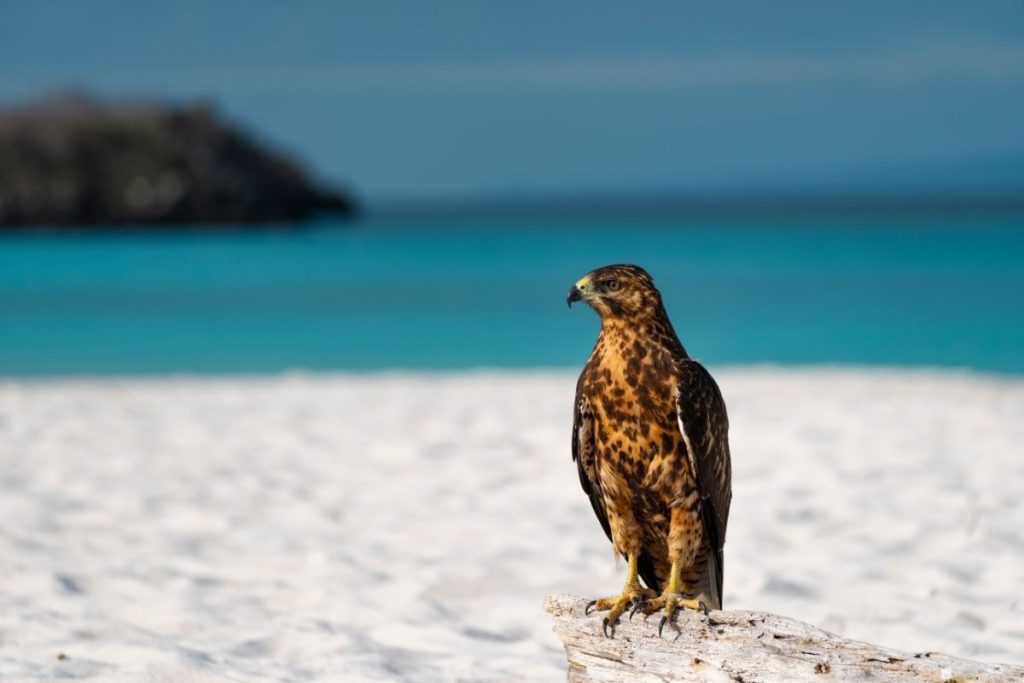
Perched atop a lava cactus with the wind in its feathers, the Galapagos hawk is a portrait of natural authority. As the apex predator of the islands — with no natural predators of its own — it has evolved to show no fear of humans, allowing for remarkably close observation. Conservation Status: Vulnerable | Habitat: Dry zones, open lava fields, and island interiors
Endemic to the Galapagos and present on most of the major uninhabited islands, the hawk plays a critical role in controlling populations of marine iguanas, small lava lizards, and invasive rodents. Its presence is a marker of a healthy Galapagos ecosystem — and one of the great rewards of exploring the more remote islands with our naturalist guides.
The Galapagos: A Living Laboratory of Evolution
In 1835, a young naturalist named Charles Darwin stepped ashore in the Galapagos aboard HMS Beagle and encountered something that would change the course of scientific history. What he observed — the subtle variations in beak shape among finches on different islands, the distinct shell forms of tortoise populations — laid the intellectual groundwork for On the Origin of Species and the theory of evolution by natural selection.
What makes the Galapagos so uniquely valuable to science — and to every guest who visits — is a phenomenon called adaptive radiation: the process by which species colonize new environments and evolve into distinct forms to fill available ecological niches. Because the islands are geologically young and were never connected to the South American mainland, the species that arrived had to adapt entirely to new conditions — with no competitors, no predators, and extraordinary ecological freedom. The result is an archipelago where evolution in the Galapagos is not a historical event but an ongoing, observable process.
This is something we think about deeply at Ecoventura. Every naturalist guide aboard our yachts is trained not just to identify species, but to tell the story of how and why they came to be. We believe that understanding the science of what you’re seeing transforms a wildlife encounter into something far more profound — a direct conversation with 3.5 billion years of life on Earth.
Conservation & Responsible Travel: Our Commitment to the Islands
The Galapagos Islands are protected by some of the most rigorous conservation policies in the world. Approximately 97% of the archipelago’s land area is designated as national park, and Ecuador’s government tightly regulates visitor access, tour operator licensing, and on-island behavior. This isn’t bureaucracy — it’s the reason the Galapagos still exists as it does today.
At Ecoventura, we don’t just comply with these regulations — we go beyond them. Our sustainability initiatives and conservation partnerships reflect our belief that responsible wildlife tourism is the most powerful tool we have to protect the natural world. When tourism is done right, it creates the economic incentive for conservation — making wildlife worth more alive than exploited.
Here is how we put that belief into practice:
- Small-group expeditions (20 guests maximum): Minimizing our footprint on fragile ecosystems while maximizing the quality of each guest’s experience.
- Expert certified naturalist guides: Every visitor landing is led by a licensed guide trained in Galapagos National Park protocols.
- Zero single-use plastics policy: We have eliminated single-use plastics across all three of our yachts.
- Active partnerships with conservation organizations: We support ongoing research and restoration projects in the Galapagos.
- Strict wildlife interaction protocols: Maintaining safe distances, never feeding animals, and always following national park guidelines.
Explore our sustainability page, learn about our conservation efforts, discover our luxury yachts, and browse our itineraries to find the expedition that speaks to you.

Experience Wildlife Intimately, Not Invasively
There’s a difference between seeing wildlife and truly experiencing it. We’ve built our entire philosophy around that distinction.
Aboard Origin, Theory, and Evolve, you’ll never be part of a crowd. With a maximum of 20 guests and our intimate small-ship format, every landing, every snorkel, every sunrise over volcanic terrain belongs to you and the small group of fellow travelers alongside you. Our naturalist guides don’t just point at animals — they bring you into the story of the place, connecting each encounter to the deeper ecological and evolutionary narrative of the Galapagos.
We believe that the best wildlife encounters are the ones that leave the animal undisturbed and the traveler permanently changed. That’s the promise behind everything Ecoventura does — not luxury for its own sake, but luxury in service of something larger: a deeper connection with the natural world.