

There are moments in the Galapagos that stop you completely. Not because of noise or spectacle, but because of something quieter — the sudden awareness that you are exactly where you’re meant to be, at exactly the right time, something relatively few travelers experience at the right time.
For us at Ecoventura, that moment unfolds each year on Española Island, as the waved albatross returns for its breeding season — a remarkable cycle that spans from April through December.
While the Galapagos is a year-round destination, certain moments, like the albatross courtship on Española, stand apart.
This is not a general Galapagos experience. This is one island, one season, one ritual — carefully protected by the Galapagos National Park. Our itineraries, approved by the Park, include visits to Española Island, where witnessing the albatross courtship dance becomes one of the most extraordinary wildlife encounters in the Galapagos. Explore our itinerariesto see when you can experience it.
Why April Is a Defining Moment on Española Island
April marks the beginning of the breeding season — and one of its most active and visually captivating periods. During this time, thousands of breeding pairs gather to reunite, bond, and begin their intricate courtship rituals.
While the birds remain on the island through December, each stage of the season offers something different — from courtship displays in April and May to nesting, hatching, and chick-rearing in the months that follow.
Our itineraries, approved by the Galapagos National Park, take place during this seasonal window, allowing guests to experience this remarkable moment in the albatross breeding cycle.
A Bird That Defies Expectations
With a wingspan reaching up to 2.4 meters, the waved albatross is the largest bird species in the Galapagos by wingspan. Built for the open ocean, it can travel vast distances without flapping its wings, riding air currents with remarkable efficiency.
And yet, on land, it becomes something entirely different.
Deliberate. Expressive. Almost theatrical.
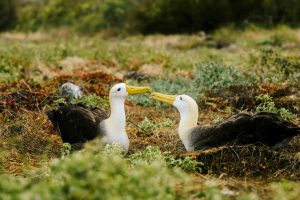
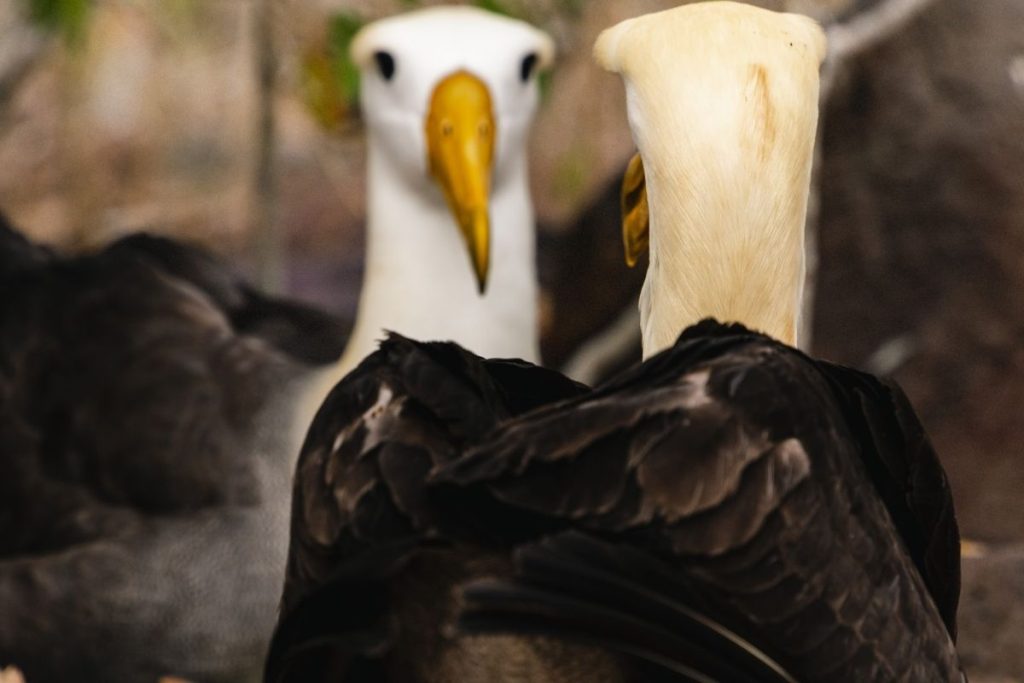
It clacks its bill like a castanet. It bows. It sways. It meets its partner’s gaze with a stillness that feels unexpectedly intimate. What begins as observation often becomes something deeper — a sense of connection that surprises even seasoned travelers.


A Courtship Ritual Refined Over Millennia
The waved albatross courtship dance is one of the most iconic rituals in the natural world — studied extensively, yet rarely witnessed in person.
Each movement plays a role in reinforcing lifelong pair bonds:
- Bill circling — slow, mirrored arcs traced between partners
- Sky-pointing — both birds stretch upward in perfect symmetry
- Bill clacking — rapid, rhythmic sounds that echo across the colony
- The bow — a deliberate lowering of the head, repeated in quiet synchronization
Waved albatrosses form long-term pair bonds, often lasting for life, returning to the same partner year after year. Over time, these rituals become not just instinctive, but deeply familiar — a choreography shaped by repetition, memory, and time.
Española Island: Where Almost the Entire Population Returns
Española Island is home to nearly the entire global breeding population of waved albatrosses. A much smaller colony exists on Isla de la Plata, off mainland Ecuador, but the species depends overwhelmingly on this single island.
This makes Española one of the most important seabird breeding sites on the planet.
It is also one of the oldest islands in the Galapagos archipelago. Over millions of years, it has drifted away from the volcanic hotspot, becoming lower, flatter, and more exposed than younger islands like Fernandina or Isabela.
The landscape feels elemental — wind-shaped, sunlit, and open. And within it, the unexpected: albatross pairs nesting quietly in the scrub, completely at ease in their environment.
Beyond the albatross, Española is home to:
- Nazca boobies
- Red-billed tropicbirds
- Española mockingbirds
- The vividly colored Española marine iguana
A single morning here reveals layers of life — the albatross may draw you in, but the island holds your attention.
What Expert Naturalist Guides Reveal
There is a version of this experience where you walk the trail, observe the birds, take photographs, and return.
And then there is the Ecoventura experience.
All guides are certified by the Galapagos National Park, with extensive experience guiding across the islands. Many have spent decades guiding on Española, developing a deep familiarity with the island’s rhythms.
They recognize active nesting areas before the season begins. They read subtle behavioral cues. They understand when a pair is newly formed or long-established.
This insight transforms what you’re seeing. It adds context, meaning, and emotional depth — turning observation into understanding.

Why 20 Guests Changes Everything
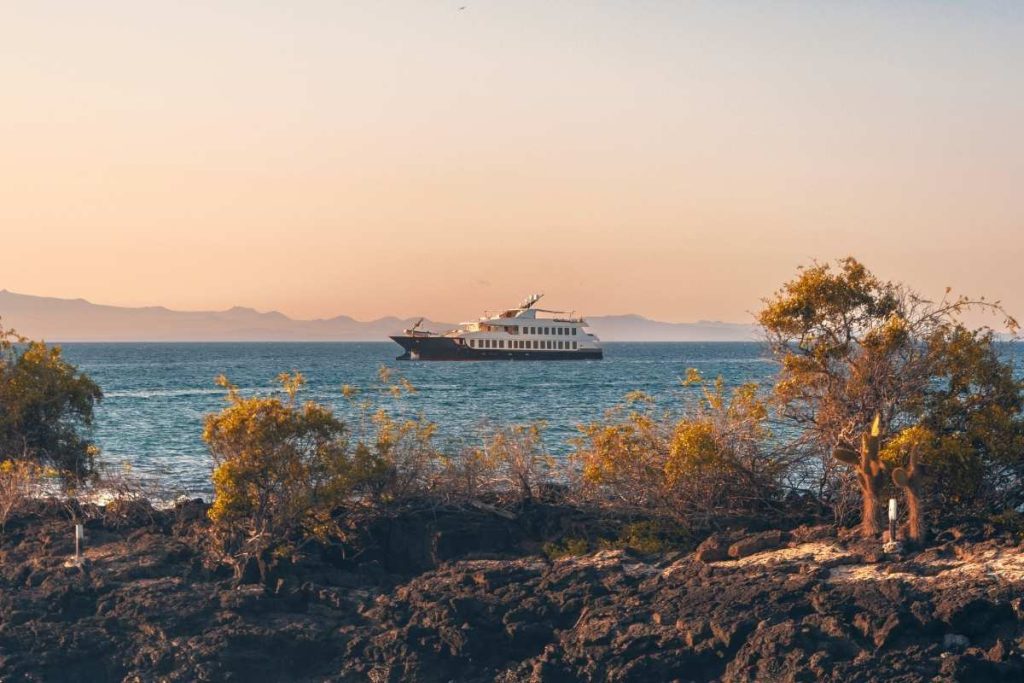
Ecoventura’s yachts — Origin, Theory, and Evolve — carry a maximum of just 20 guests.
This isn’t a detail. It’s fundamental to the experience.
The Galapagos National Park regulates all visitor sites.. Larger vessels must divide passengers into multiple groups, rotating landings and limiting time ashore.
With 20 guests, we explore together — minimizing the need for group rotation and allowing for a more seamless experience.
Within park regulations, this allows us to:
- Maximize our time at key wildlife sites
- Move at a natural, unhurried pace
- Spend longer observing meaningful moments
- Maintain space, silence, and immersion
In a place like Española, that difference is everything.
Protected by Design
The Galapagos National Park protects 97% of the archipelago’s land area, carefully regulating every visitor experience.
This includes:
- Fixed landing sites and trails
- Strict visitor quotas
- Mandatory certified guides
- Controlled timing and access
These measures are not limitations — they are the reason the Galapagos remains one of the most pristine ecosystems on Earth.
Ecoventura has operated in partnership with the Park since 1990, aligning closely with its conservation mission. The result is a travel experience built on respect, responsibility, and long-term sustainability.
Is This the Right Journey for You?
Our itineraries are designed for a certain kind of traveler.
They’re for you if:
- You seek rare, time-specific wildlife encounters
- You value depth over checklist travel
- You want expert interpretation, not just observation
- You prefer small groups and meaningful experiences
- You’re willing to travel on nature’s terms
If standing quietly on Española in April, watching two albatrosses bow toward each other, resonates with you, then this is your journey.
A Limited Window, By Nature
The Galapagos is shaped by seasonality, not in terms of when to visit, but in what you experience.
While certain moments, like the waved albatross courtship on Española, occur within a specific window, each time of year reveals its own extraordinary wildlife encounters.
From seabird nesting cycles to shifting marine activity and unexpected sightings, no two departures are ever the same.
What remains constant is the sense of discovery, of being present for something unscripted, unfolding in real time.Explore our special offers and available departures to find the experience that’s right for you.
We’d love you to be one of them
Reach out to our expedition team to explore upcoming departures aboard Origin, Theory, or Evolve, our Relais & Châteaux yachts in the Galapagos.
We’ll help you find the time that’s right for your journey.