

If you’ve ever dreamed of standing somewhere that feels truly untamed—where sea lions lounge on park benches and blue-footed boobies wander past without a second glance—San Cristóbal Island is where that dream becomes real.
This is not a place defined by a single dramatic moment, but by a quiet, persistent feeling: that you’ve stepped into a world that still moves to its own rhythm.
Why San Cristóbal Is Unlike Any Other Island in the Galápagos
San Cristóbal holds a unique place within the archipelago—one that many travelers only fully appreciate once they arrive. As one of the easternmost and geologically oldest islands, it has long since moved away from the volcanic hot spot that formed the Galapagos, meaning there is no active volcanism today.
Instead, the island was shaped by multiple volcanic formations over time, resulting in a softer, more eroded landscape. What that means for visitors is something rare in the Galapagos: lush highlands, varied ecosystems, and noticeable microclimates as you move from arid coastlines into mist-covered greenery.
At the heart of this ecological richness lies El Junco Lagoon, the only permanent natural freshwater lake in the Galapagos. Fed by rain and garúa (highland mist), it played an important role in the island’s early settlement, which later supported the development of Puerto Baquerizo Moreno as the capital of the Galapagos Province, a relaxed coastal town where daily life unfolds alongside sea lions sprawled across the waterfront.
And for wildlife enthusiasts, San Cristóbal offers something exceptional: it is one of the few islands in the Galapagos where all three booby species—blue-footed, Nazca, and red-footed—can be found, particularly at Punta Pitt.


A Brief History: Darwin and the Origins of Discovery
In September 1835, Charles Darwin first arrived in the Galapagos at San Cristóbal, then known as Chatham Island. Observations made here—including those of the local mockingbird species—would later contribute to the development of his theory of evolution.
Early settlement attempts began in the 1830s in the island’s highlands, supported by its rare freshwater resources. More permanent communities developed later in the 19th century, eventually leading to the establishment of Puerto Baquerizo Moreno as the administrative center it remains today.
For travelers interested in both natural and human history, the island offers a deeper, more layered understanding of the Galapagos story—one that includes exploration, exploitation, and ongoing conservation.

Wildlife Encounters: Remarkably Close, Entirely Real
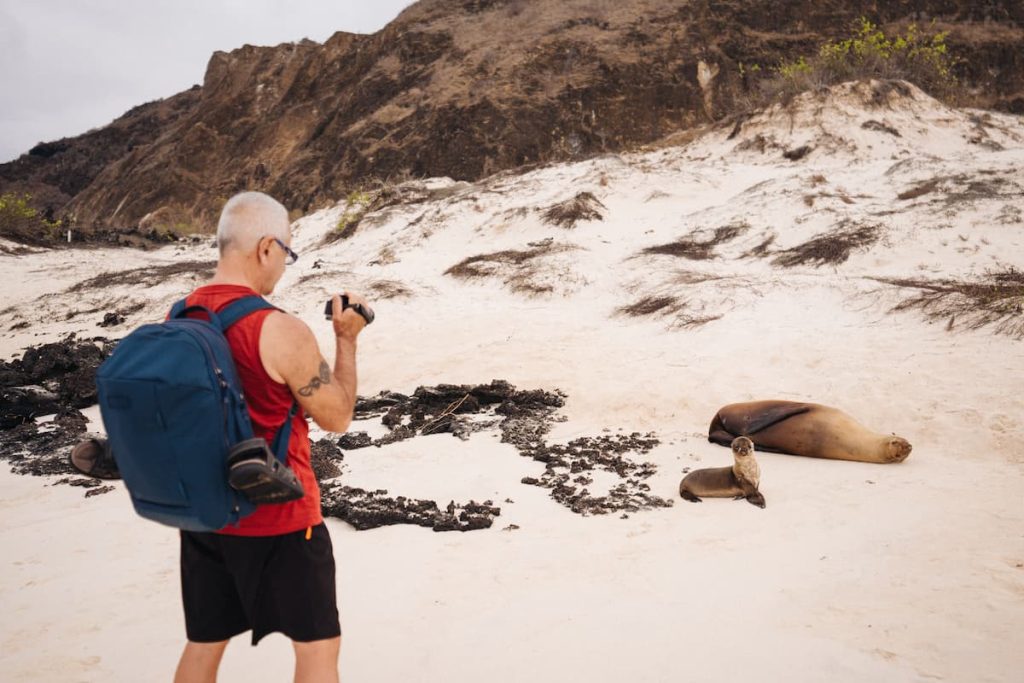
One of the most striking aspects of San Cristóbal is how close you can get to wildlife. Animals here evolved with few natural predators on land, and as a result, they show little fear of humans.
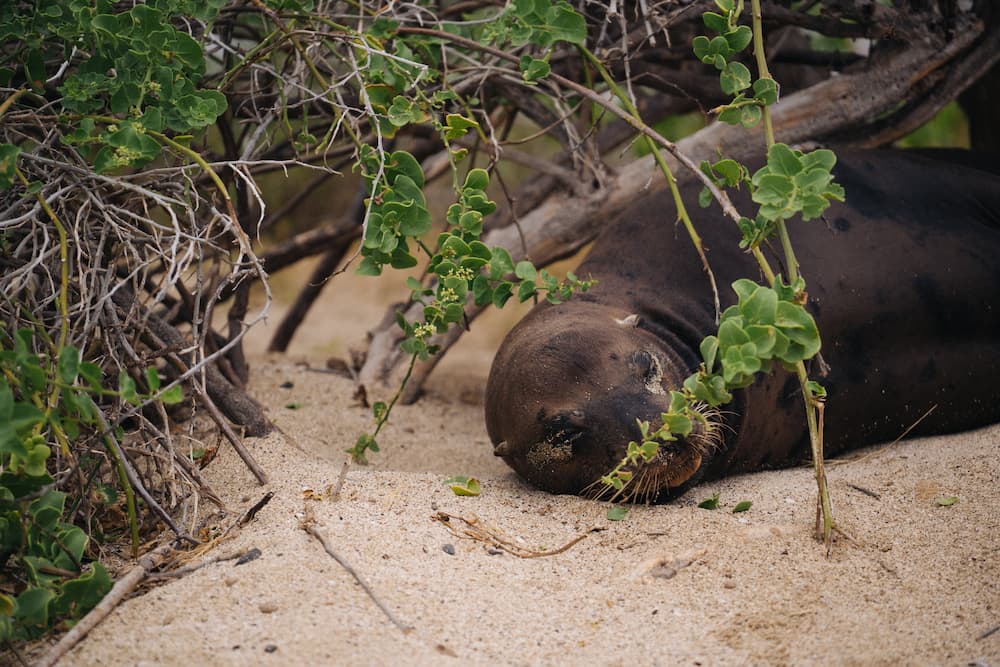
Sea lions slip through the harbor and nap along the promenade. Marine iguanas bask on black lava rocks. Darwin’s finches hop between café tables. The experience is immersive, unscripted, and quietly extraordinary.
Species to Look For
- San Cristóbal mockingbird – endemic to the island
- Blue-footed, Nazca, and red-footed boobies – all present on the island
- Galapagos sea lions – abundant and ever-present
- Marine iguanas – found along the coastline
- Darwin’s finches – central to evolutionary science
- Frigatebirds – both great and magnificent species nest here
- Galapagos giant tortoise – seen in highland reserves




Top Visitor Sites
Kicker Rock: A Dramatic Icon Above and Below Water
Rising sharply from the ocean, Kicker Rock is one of the most iconic formations in the archipelago. This eroded eroded volcanic formation, split into two towering walls, creates a narrow channel teeming with marine life.
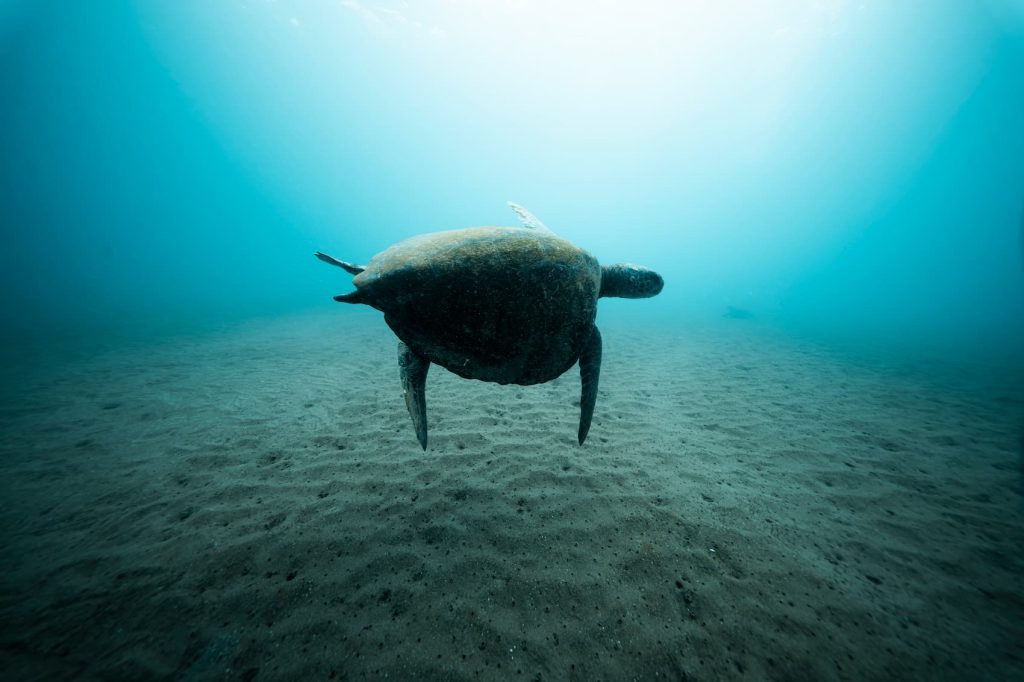
Below the surface, divers and snorkelers may encounter hammerhead sharks, sea turtles, rays, and large schools of fish. Above, frigatebirds and boobies nest along the cliffs.
El Junco Lagoon: Freshwater in the Pacific
Set within a volcanic crater, El Junco Lagoon offers a completely different perspective of the islands. The journey upward passes through distinct vegetation zones, culminating in panoramic views over the island.
Frigatebirds are often seen here rinsing their feathers in freshwater—an unusual and memorable sight.
Cerro Colorado: Giant Tortoise Conservation
The Cerro Colorado reserve protects populations of the Galapagos giant tortoise through a semi-natural breeding and rearing program.
Visitors can walk short trails through native vegetation while observing tortoises in environments that closely resemble their natural habitat.
Puerto Baquerizo Moreno & Interpretation Center
Life in Puerto Baquerizo Moreno unfolds at an unhurried pace. Sea lions occupy benches along the malecón, and the town retains a distinctly local feel compared to busier islands.
The nearby Interpretation Center provides valuable context on:
- Volcanic formation
- Species migration
- Human history
- Conservation efforts
From here, trails lead to Tijeretas Hill, where both species of frigatebirds nest—one of the few easily accessible places where both species can be observed nesting in close proximity.
Cerro Brujo: A Coastal Landscape in Motion
Cerro Brujo offers one of the most visually striking coastal settings on San Cristóbal. Along this stretch of coastline, seabirds glide overhead while marine life moves just beneath the surface, creating a constant sense of quiet activity.
Its luminous coral-sand beach is often dotted with sea lions resting along the shore, while marine iguanas navigate the tide line. Dramatic rock formations—often referred to as “The Cathedral”—frame the landscape, shaped over time by wind and sea.
The experience here is unhurried, allowing time to walk, observe, and, conditions permitting, enter the water in areas where sea lions are often present.

Best Time to Visit
The Galapagos can be visited year-round, but seasonal shifts shape the experience:
- December to May (warm season)
Warmer waters (22–26°C), calmer seas, greener landscapes, excellent snorkeling - June to November (cool season)
Cooler, nutrient-rich waters attract abundant marine life—ideal for diving and wildlife activity
How to Get There
San Cristóbal is one of the main entry points to the Galapagos, with flights arriving from mainland Ecuador via Quito or Guayaquil, often connecting through Guayaquil.
The island is served by San Cristóbal Airport, one of the two main airports used for commercial flights into the archipelago.
Is San Cristóbal Worth Visiting?
Without question.
San Cristóbal may not have the dramatic volcanic scale of Isabela Island or the raw intensity of Fernandina Island, but what it offers is something more complete.
Here, you’ll find:
- A living town shaped by nature
- Wildlife encounters that feel entirely unfiltered
- A rare freshwater ecosystem
- A deep connection to the origins of evolutionary science
It’s a place that rewards those willing to slow down, observe, and simply be present.
And long after you leave, it’s often the feeling of San Cristóbal—not just its sights—that stays with you.
At Ecoventura, we invite our guests to experience San Cristóbal not simply as a destination, but as the beginning of a deeper connection with the Galapagos. Our journeys start in Puerto Baquerizo Moreno, where we welcome you aboard and set the tone for the days ahead.
On our Beaches & Bays itinerary, we explore the archipelago’s more tranquil side—navigating pristine coastlines, visiting sites like Kicker Rock, and guiding you through places such as Punta Pitt, where wildlife encounters feel remarkably intimate. For those seeking a more dramatic expression of the islands, our Volcanic Wonders itinerary ventures further west to the younger, untamed landscapes of Isabela Island and Fernandina Island, where volcanic forces continue to shape the environment.
Across both journeys, we design each day to unfold with intention—through guided explorations, snorkeling, and quiet moments of reflection—while life on board offers a level of comfort, cuisine, and care that enhances, rather than distracts from, the extraordinary world just beyond the deck.