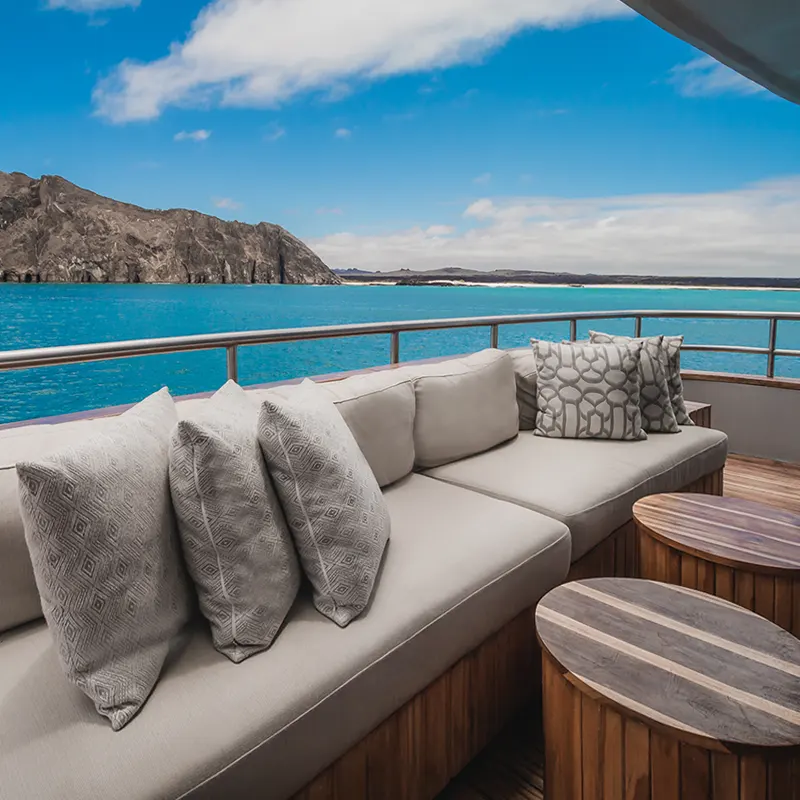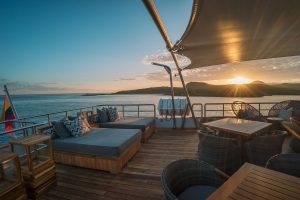


Onboard Origin, Theory, and Evolve, gastronomy is not an amenity, it is a voyage in itself. As the only expedition yachts in the Galapagos honored by Relais & Châteaux, Ecoventura elevates dining at sea into a chef-driven, multi-course tasting journey anchored in Galapagos terroir. Here, more than half of the ingredients are sourced directly from the islands, translating volcanic landscapes, Pacific waters, and Ecuador’s extraordinary biodiversity into refined, contemporary cuisine. Each evening unfolds as an intimate culinary narrative — thoughtfully paired wines, locally inspired flavors, and personalized service that could only exist aboard a 20-guest yacht. For travelers seeking a true fine dining at sea experience in the archipelago, this is gastronomy rooted in place, crafted with intention, and served against one of the world’s most iconic backdrops.
Among the talented chefs bringing this culinary vision to life onboard is Chef Cristhian Murrieta, a long-standing member of Ecoventura’s culinary team. Since 2016, he has contributed his expertise and creativity to the evolving gastronomic experience across the fleet. In the following interview, he shares his perspective on sourcing Ecuadorian ingredients, collaborating on wine pairings, and crafting dishes that reflect the flavors of the region within the intimate setting of a Relais & Châteaux expedition yacht.

1. How would you describe the dining experience on Origin, Theory and Evolve?
Dining onboard Origin, Theory and Evolve is designed to feel intimate, rooted in place, and deeply connected to the Galapagos. Since joining Ecoventura in 2016, my goal has always been to move beyond the idea of “cruise dining” and instead create an experience that reflects Ecuador’s culinary richness in a refined, contemporary way.
Our menus are inspired by the landscapes our guests explore each day — volcanic islands, pristine waters, and vibrant ecosystems — and translate that sense of discovery onto the plate. More than half of our ingredients are sourced directly from the Galapagos, allowing us to cook with exceptional freshness while supporting local producers.
Every meal is an invitation to taste Ecuador: coastal flavors, Andean influences, tropical fruits, and modern culinary techniques come together to create a dining experience that feels both sophisticated and authentic.


2. What makes fine dining on a small ship different from dining on larger cruise vessels?
On a small yacht, dining becomes personal. We cook for a limited number of guests, which allows us to focus on precision, freshness, and customization in a way that simply isn’t possible on larger ships.
Because our kitchens operate on a smaller scale, we can adapt menus daily, respond to guest preferences, and highlight ingredients at their peak. There is a closeness between the culinary team and our guests — we interact, share stories, and adjust experiences in real time.
This intimacy transforms dining into something more meaningful: it feels less like a service and more like being welcomed into a chef’s private table at sea.
3. How do Ecuadorian and Galapagos-inspired ingredients shape your menus onboard?
Ecuador’s biodiversity is extraordinary, and it is the foundation of everything we do in the kitchen. Throughout the season, we regularly feature seafood such as brujo, red tuna, seabass, robalo, and smoked trout, each selected according to freshness and availability.
Brujo, a local rockfish, is especially appreciated for its flaky texture and clean, ocean-driven flavor, while red tuna offers richness and depth ideal for precise preparations. Corvina and robalo bring a clean, mild profile that reflects the purity of Pacific waters, while smoked trout from the Andean lakes brings a subtle smokiness that reflects Ecuador’s rich highland landscapes.
This commitment influences not only flavor but philosophy. Each dish expresses the identity of the archipelago, the ocean, the farms, and the cultural traditions of Ecuador. Cooking in the Galapagos means honoring the environment and working in harmony with it, allowing sustainability and seasonality to guide our creativity every day.


4. Which local ingredients from Ecuador are you most excited to work with, and why?
I am constantly inspired by Ecuador’s incredible variety of ingredients. Plantains are among my favorites because of their versatility, whether prepared as crispy patacones, caramelized maduros, or smooth purées that accompany our seafood dishes.
Ecuadorian cacao, particularly from the coastal region, is exceptional and allows us to create desserts with remarkable depth and complexity. I also enjoy working with Andean grains such as quinoa and amaranth, which add texture and nutritional richness, as well as fruits like passion fruit and tree tomato, whose natural acidity and brightness elevate sauces and desserts.
These ingredients are not only delicious, but they also reflect the diversity of Ecuador’s coast and highlands, connecting our cuisine to the land and its culinary heritage.
5. How do you balance international culinary techniques with the authentic flavors of Ecuador?
My approach is to respect Ecuadorian ingredients and traditions while applying modern culinary techniques that elevate them without overshadowing their essence.
We draw inspiration from global fine dining, but the heart of each dish remains local. Techniques serve to refine texture, presentation, and balance, allowing natural flavors to shine. The result is cuisine that feels contemporary and elegant, yet unmistakably Ecuadorian.
This balance is essential: guests experience something familiar in quality and technique, but entirely unique in flavor.

6. Can you walk us through a signature dish that truly represents the spirit of the Galapagos?
One dish that captures the spirit of the Galapagos is our seared local grouper (mero), served with a smooth green plantain purée finished with salprieta, a traditional seasoning from Ecuador’s coastal region made from toasted peanuts, ground corn, and spices, alongside seasonal island vegetables.
Grouper is prized for its firm yet delicate texture, similar to sea bass, but slightly meatier, which allows us to achieve a precise sear while preserving its natural moisture and clean flavor.
The plantain connects the dish to everyday Ecuadorian cuisine, while the salprieta adds a subtle nuttiness and depth that reflects the culinary traditions of the coast. The plating remains clean and modern, mirroring the raw beauty and simplicity of the Galapagos landscape.
It is a dish that feels both comforting and refined, a true expression of place.

7. How do you approach wine pairings onboard, and what makes them special in this setting?
Wine pairing is an essential part of the dining experience. We curate a selection that highlights South American wines, including collaborations with Bodega Dos Hemisferios, a respected Ecuadorian winery.
These pairings are designed to complement our menus and enhance regional flavors. Sharing wines from Ecuador alongside locally inspired dishes creates a cohesive narrative — guests taste the country through both food and wine.
The intimate setting of the yacht allows us to introduce wines personally and explain their story, turning each pairing into a conversation.

8. How does the size of the yacht influence the creativity and personalization of your menus?
The intimacy of a 20-guest yacht allows for a level of personalization that would be impossible on a larger vessel. With fewer guests onboard, we can better understand individual preferences and dietary needs, adapting menus and presentation accordingly.
This scale encourages creativity rooted in precision and detail — crafting dining moments that feel thoughtful, refined, and truly tailored to the experience onboard.
9. How do you accommodate dietary preferences while maintaining a refined, chef-driven dining experience?
Accommodating dietary preferences is an opportunity to be creative rather than restrictive. Whether guests require gluten-free, vegetarian, vegan, or other specialized options, we approach each request with the same level of care and culinary intention.
Our goal is that every guest enjoys a dining experience that feels complete and thoughtfully crafted. We design alternative dishes that maintain balance, flavor, and elegance, ensuring that no one feels they are receiving a substitute — but rather a dish created specifically for them.

10. As a member of Relais & Châteaux, how does this distinction influence your culinary philosophy and the level of fine dining guests can expect onboard in the Galapagos?
Being part of Relais & Châteaux reinforces our commitment to excellence, authenticity, and a deep respect for local culture and terroir.
This distinction encourages us to continuously refine our craft and celebrate Ecuador’s culinary heritage. Through collaborations with fellow Relais & Châteaux chefs and our culinary departures — including partnerships with renowned chefs and Bodega Dos Hemisferios — we bring fresh inspiration and innovation onboard.
For our guests, this means experiencing fine dining that meets international standards while remaining intimately connected to the Galapagos and Ecuador.

Upcoming Culinary Departure – October 18–25, 2026 (Itinerary A)
Ecoventura continues its acclaimed series of chef-hosted departures in 2026 with a special sailing from October 18–25, welcoming Chef Heberto Eljach of Relais & Châteaux Casa Pestagua in Cartagena.
Cartagena-born and of Lebanese heritage, Chef Heberto has served for over a decade as Executive Chef of the prestigious Casa San Agustín (LHW) and Casa Pestagua (Relais & Châteaux), both landmarks of luxury hospitality in Colombia. In 2025, Casa Pestagua was honored with Two Michelin Keys, further elevating its international recognition.
A distinguished ambassador of Colombian cuisine, Chef Heberto is known for honoring ancestral techniques and local ingredients while presenting them through a refined, contemporary lens. Guests onboard will experience exclusive menus designed especially for this sailing — a celebration of Latin American flavors reimagined in the extraordinary setting of the Galapagos.